Guide
Cricket Formats Explained: Test, ODI, T20, T10 and The Hundred
Every format of cricket uses the same bat, ball and laws. What changes is how long each side bats, how many overs one bowler may bowl and where the fielders may stand. This guide puts the formats side by side.
By the Crics Live desk · Updated 12 November 2026
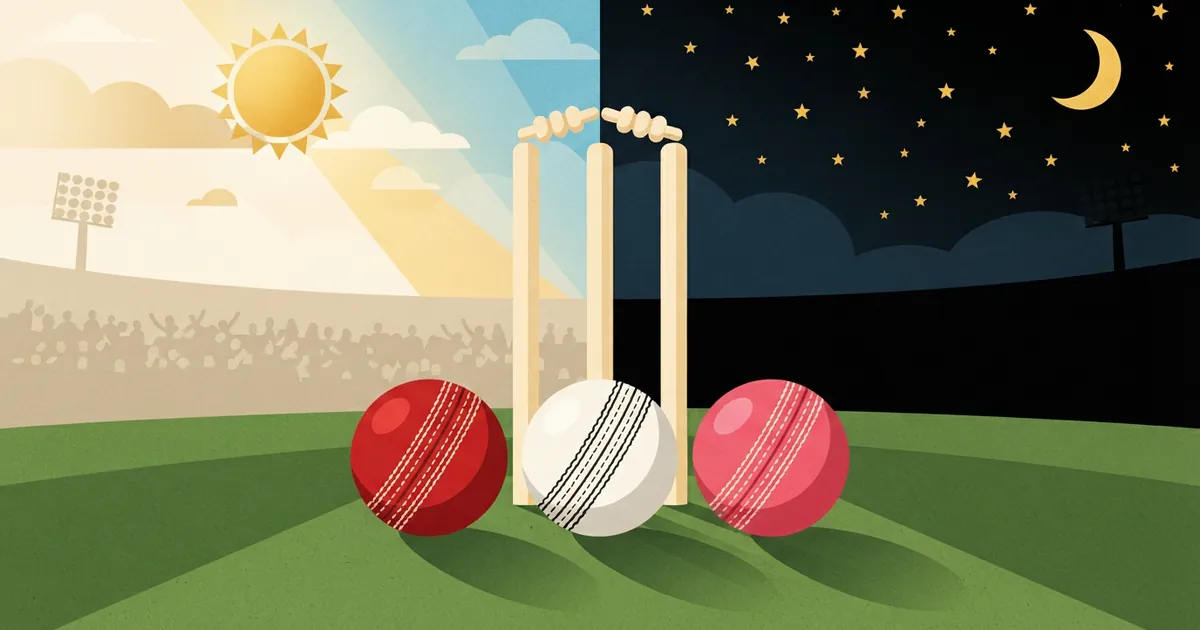
The formats at a glance
An over is six legal balls bowled by one bowler from one end. Formats are named after how many overs, or balls, each side gets to bat. A Test has no over limit at all. It is limited by time instead.
| Format | Length of one innings | Innings per side | Most one bowler may bowl | Rough match time |
|---|---|---|---|---|
| Test | No over limit | Two | No limit | Up to five days |
| ODI | 50 overs | One | 10 overs | Most of a day |
| T20 | 20 overs | One | 4 overs | About three hours |
| T10 | 10 overs | One | 2 overs | About an hour and a half |
| The Hundred | 100 balls | One | 20 balls | About two and a half hours |
ODI, T20, T10 and The Hundred are all called limited-overs cricket. In each one the bowling limit is one fifth of the innings, so a side needs at least five bowlers.
Test cricket
A Test match lasts up to five days. Each side bats twice, so there can be four innings in the match. An innings ends when ten batters are out or when the captain declares, which means choosing to stop batting to save time.
A day is split into three sessions with breaks for lunch and tea, and about 90 overs are planned for each day. Players wear white and use a red ball. Day-night Tests use a pink ball because it is easier to see under lights. After 80 overs with one ball, the fielding captain may take a new one.
To win, a side must score more runs across its two innings and also bowl the other side out twice. That second part matters. If time runs out before the last innings is finished, the match is a draw, even if one side is far ahead.
The follow-on is a Test rule you will see on scorecards. In a five-day match, if the side batting first leads by 200 runs or more after both first innings, its captain may ask the other side to bat again straight away.
One-day internationals
An ODI gives each side one innings of 50 overs. The match finishes in a single day. No bowler may bowl more than 10 overs, so a captain has to plan who bowls at the start, in the middle and at the end.
Players wear coloured kit and use a white ball. The side batting second knows its target from the first ball of the chase. That makes the required run rate the key number in the second innings. You can work it out at any point with the Crics Live run rate calculator.
An ODI innings has three phases. In the first 10 overs most fielders must stay close, so batters can hit over the top. The middle overs are about building without losing wickets. The last 10 overs are for fast scoring with wickets in hand.
T20 cricket
T20 gives each side one innings of 20 overs. A bowler may bowl at most 4 overs. The first six overs are the powerplay, when only two fielders may stand outside the inner circle.
With only 120 balls to face, batters attack from the start. A score of 8 runs an over is ordinary in T20 but would be very fast in a Test. Wickets matter less than in longer formats because a side rarely runs out of batters in 20 overs. Dot balls, which are balls with no run scored, matter more.
Most domestic leagues around the world use T20 rules. If you are new to the numbers on a T20 card, the guide on how to read a cricket scorecard explains each column.
T10 and The Hundred
T10 cuts the innings to 10 overs, which is 60 balls. A bowler may bowl at most 2 overs. A whole match takes about as long as a football game. With so few balls, almost every one is an attacking shot.
The Hundred counts balls instead of overs. Each side faces 100 balls. A bowler delivers five balls at a time and may bowl ten in a row if the captain wants. No bowler may bowl more than 20 balls in the innings. The bowling switches ends after every ten balls, and the powerplay lasts for the first 25 balls.
Scoreboards in The Hundred usually show runs scored and balls left, which is simpler for new fans than overs and decimals.
Powerplays, fielding and bowling limits
Limited-overs grounds have an inner circle marked 30 yards from the pitch. A powerplay is a set of overs when the fielding side may keep only a small number of fielders outside that circle. It gives batters gaps in the deep early on.
| Format | Phase | Fielders allowed outside the circle |
|---|---|---|
| ODI | Overs 1 to 10 | Two |
| ODI | Overs 11 to 40 | Four |
| ODI | Overs 41 to 50 | Five |
| T20 | Overs 1 to 6 | Two |
| T20 | Overs 7 to 20 | Five |
| The Hundred | Balls 1 to 25 | Two |
Tests have no powerplay and no circle rule. One fielding law applies in every format: no more than two fielders may stand behind square on the leg side when the ball is bowled.
Bowling limits shrink when rain shortens a match. The usual rule keeps the limit at one fifth of the new innings length. In every format, no bowler may bowl two overs in a row.
Short formats are also stricter on wides. A ball down the leg side that a Test umpire would let go is often called wide in a T20. And in limited-overs cricket the ball after a no-ball is a free hit, when the batter cannot be out bowled, caught or lbw.
What a result means
The result line on a scorecard uses a few fixed phrases. Here is what each one means.
- Won by runs: the side that batted first won. If it made 180 and the chasing side finished on 165, it won by 15 runs.
- Won by wickets: the side that batted last won. If it passed the target with four batters out, it had six wickets left and won by 6 wickets.
- Won by an innings: Tests only. One side scored more in a single innings than the other managed in two.
- Draw: Tests only. Time ran out before the match could be finished.
- Tie: both sides finished with the same score and the match was complete. Many limited-overs competitions then play a Super Over, one extra over per side, to find a winner.
- No result: a limited-overs match that rain or bad light ended too early. Usually each side must face at least 20 overs in an ODI, or 5 overs in a T20, for a result to count.
When rain shortens a limited-overs chase, the DLS method sets a new target based on the overs and wickets each side has left. That is why a side can win a match after scoring fewer runs than its opponent.
In league stages, wins earn points and level teams are split by net run rate, which rewards scoring fast and bowling tightly. The net run rate guide shows the sums, and the cricket points table shows the standings for competitions in play.
Questions and answers
What are the three main formats of cricket?
Test cricket, one-day internationals (ODIs) and T20. A Test lasts up to five days with two innings per side. An ODI gives each side 50 overs. A T20 gives each side 20 overs.
How many overs can one bowler bowl in each format?
Ten overs in an ODI, four overs in a T20 and two overs in T10. In The Hundred a bowler may bowl up to 20 balls. Tests have no limit, but nobody may bowl two overs in a row.
What is the difference between a draw and a tie?
A draw happens only in Tests and other multi-day matches, when time runs out before the match is finished. A tie means the match was completed and both sides ended on exactly the same score.
What is a powerplay in cricket?
A powerplay is a block of overs when only two fielders may stand outside the 30-yard circle. It covers the first 10 overs of an ODI innings, the first 6 overs of a T20 innings and the first 25 balls in The Hundred.
Why can a Test match end without a winner?
To win a Test, a side must bowl the opposition out twice as well as score more runs. If the last innings is still going when time runs out on the final day, the match is a draw.